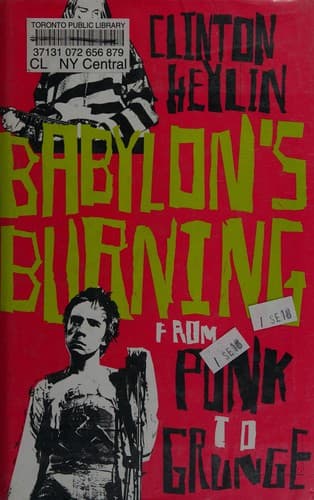
Babylon's Burning
A cynical, exhaustive dissection of punk's chaotic rise and grimy demise.
The Context of the Chaos
Clinton Heylin is a man who knows too much. Known for his exhaustive, sometimes punishingly detailed biographies of Bob Dylan, Heylin pivots his obsessive archival gaze toward the spitting, bleeding carcass of punk rock. Published in 2007, Babylon's Burning: From Punk to Grunge is not a casual read. It is a 700-page doorstop. A messy smorgasbord of facts, snark, and venom.
Punk history is usually written by the victors or the posers. We get the standard Malcolm McLaren mythos. The working-class hero narrative. The Situationist prank angle. Heylin rejects all of it. He drags the timeline back to the true ground zero. The early 1970s. The proto-punk primordial ooze of New York and the grim pub rock circuit of London.
Before the music existed, the aesthetic was already being forged. Not by musicians, mind you. By critics. Misfits. Loudmouths. People like Lester Bangs. Nick Kent. Ben Edmonds. These were the architects of the attitude. They laid the ideological groundwork for a revolution that hadn't even found its chords yet. They demanded a return to the raw, visceral energy of rock and roll. The bloated, virtuosic prog-rock of the era disgusted them. The Eagles disgusted them. Pink Floyd disgusted them. They wanted noise. They wanted danger.
Heylin meticulously documents this incubation period. He traces the lineage from the Velvet Underground to the New York Dolls. The Dolls were a beautiful, disastrous mess. They couldn't play. They didn't care. They slathered on makeup and tore through blues riffs with a chaotic, unhinged energy. Then came Suicide. Martin Rev and Alan Vega stripping rock down to its terrifying, synthesized bones. Patti Smith merging Rimbaud with three-chord garage rock. Television stretching those chords into frantic, jagged poetry.
This was the fertile crescent of punk. Not London. New York. Heylin makes this abundantly clear. He strips away the Anglocentric bias that plagues so many punk retrospectives. The Sex Pistols were a reaction, not an origin.
But Heylin doesn't ignore the UK. He just contextualizes it. The London pub rock scene was a necessary stepping stone. Bands like Dr. Feelgood playing stripped-down, aggressive R&B. It was a rejection of stadium rock. A return to the sweaty, intimate club gig. This was the environment that incubated The Clash. The Damned. The Stranglers.
The cultural context of the mid-70s is crucial here. Economic stagnation. High unemployment. The three-day week in the UK. A generation of kids with no prospects and a lot of anger. The hippie dream had curdled into a bloated, corporate nightmare. Rock music had become the soundtrack of the elite. Millionaires singing about hobbits and spaceships. Punk was the corrective measure. A brick through the window of the establishment.
Heylin captures this desperation. The sheer, ugly necessity of the movement. It wasn't a fashion statement initially. It was a survival tactic. A way to scream into the void and demand to be heard. The fanzine culture exploded. Sniffin' Glue. Punk magazine. Kids writing about their own scenes because the mainstream press ignored them. This DIY ethos is central to Heylin's thesis. Punk was about seizing the means of production. Anyone could start a band. Anyone could publish a zine. You just had to have the nerve.
This book is a documentation of that nerve. It is a chronicle of a moment when the inmates took over the asylum. Heylin writes with the sneering authority of someone who knows where the bodies are buried. He doesn't romanticize the era. He exposes the squalor. The drug abuse. The petty rivalries. The sheer amateurish incompetence that somehow coalesced into genius.
The Meat of the Matter
Babylon's Burning is fundamentally an argument about authenticity. What is punk? What isn't punk? Heylin draws hard, controversial lines in the sand. He operates on a strict, almost puritanical set of criteria.
His most provocative assertion? Real punk bands do not record second albums. It is a brilliant, infuriating metric. It implies that punk is inherently unstable. A chemical reaction that burns bright and immediately consumes itself. The moment a band enters a studio for a sophomore effort, they are compromising. They are thinking about a career. Punk, in Heylin's view, should be a suicide mission.
He applies this standard ruthlessly. The Sex Pistols? The perfect punk band. One immaculate, world-destroying record, and then implosion. The Clash? Too ambitious. Too willing to play the game. Heylin respects them, but he questions their ideological purity. The Ramones? He dismisses their later output entirely. To him, they became a cartoon version of themselves. A touring nostalgia act.
This rigid categorization extends to the bands he champions. He elevates the obscure over the famous. The "toe bones" of the scene. Eater. The Killjoys. The Saints in Australia. Radio Birdman. These were the true believers. The bands that existed on the fringes, too weird or too aggressive for mass consumption. Heylin spends pages detailing their brief, chaotic lifespans. He values their failure as much as their success. Failure, in the punk ethos, is a badge of honor. It proves you didn't sell out.

The structure of the book is exhaustive. It is a sprawling, messy timeline that reflects the chaotic nature of the subject. Heylin relies heavily on contemporary accounts. Interviews. Press kits. Liner notes. He avoids direct lyrical quotations, partly because music publishing permissions are expensive. Instead, he cunningly peppers his prose with song lines. It is a stylistic quirk that infuriates some critics. They complain that it blurs the line between his voice and the voice of the artists. But it works. It creates a rhythm. A frantic, cut-up aesthetic that mirrors the music.
One of the book's major revelations is the detailed breakdown of the business of punk. The cynical maneuvering behind the safety pins. Malcolm McLaren is often portrayed as a svengali, a mastermind who orchestrated the entire movement. Heylin demystifies him. He shows McLaren as a chaotic opportunist. A man who stumbled into a cultural earthquake and tried to sell tickets. The real power, Heylin argues, lay with the record executives who figured out how to package rebellion.
Heylin also tackles the dark side of the scene. The self-destruction. The violence. His take on Sid Vicious is particularly brutal. He doesn't romanticize Sid as a tragic punk martyr. He views him as a pathetic, talentless junkie. Heylin controversially characterizes the death of Nancy Spungen as "justifiable homicide." It is a shocking, callous statement. A deliberate provocation. But it fits the cynical tone of the book. Heylin refuses to sanitize the ugliness.
The narrative eventually drags itself into the 1980s. The post-punk fragmentation. The rise of hardcore in America. Black Flag. Minor Threat. The DIY ethic mutating into a rigid, humorless orthodoxy. Heylin covers it all with a jaundiced eye. He sees the initial burst of punk creativity calcifying into rules and uniforms. The very thing it was meant to destroy.
The Aftermath and the Agony
The final section of Babylon's Burning is perhaps its most contentious. Heylin follows the thread of punk into the Pacific Northwest. Grunge. He frames the Seattle scene as punk's last, desperate gasp. A final attempt to inject raw, unvarnished truth into the mainstream rock apparatus.
His analysis of Nirvana is sharp and unsentimental. He portrays Kurt Cobain not as a tortured generational spokesman, but as a rock star who fundamentally betrayed the punk ideology he claimed to worship. Cobain, in Heylin's estimation, succumbed to the exact hypocrisy he spent his life railing against. He wanted the underground cred, but he also wanted the MTV rotation. The contradiction tore him apart.
Some critics found this portrayal intriguing. A necessary corrective to the overwhelming hagiography that surrounds Cobain. Others found it deeply remiss. They argued that Heylin downplayed the severe reality of Cobain's addiction and mental illness, reducing his tragedy to a failure of punk ethics. It is a harsh assessment. But Heylin is a harsh writer. Empathy is not his strong suit. Historical rigor is.
The legacy of Babylon's Burning is complex. It is widely regarded as an essential, if deeply flawed, text. It is a book that demands to be argued with. You cannot read it passively. Heylin's opinions are too loud. Too aggressive. He excoriates other music writers with gleeful malice. He dismisses beloved bands with a wave of his hand. It is a polarizing work.
But its sheer scale is impossible to ignore. It is a monumental achievement of archival research. Heylin dug through decades of fanzines, bootlegs, and forgotten interviews to construct this narrative. He created a 4-CD companion compilation to accompany the book. It was a bizarre collection. Full of rare demos and tracks from neglected scenes, like Cleveland's proto-punk weirdos. It conspicuously omitted essential tracks from major bands like The Clash. Typical Heylin. Always prioritizing the obscure over the obvious. The difficult over the easy.
The book's controversies only cemented its status. It became a lightning rod for debates about punk purity. What belongs in the canon? Who gets to decide? Heylin staked his claim with maximum volume and zero apologies. He proved that music history doesn't have to be polite. It doesn't have to be objective. It can be just as noisy and obnoxious as the music it describes.
In a market filled with lazy journalism, Babylon's Burning stands out. It is a challenge. A gauntlet thrown down. It forces the reader to re-examine their own assumptions about rock history. It asks uncomfortable questions about commerce, art, and the inevitable decay of youth movements.
Heylin operates without an ounce of pity. He strips the mythology down to the rusted chassis. The book is an exhaustive documentation of a failure that accidentally redefined the world. He weaponizes history itself, ending his ideological arguments with the same ruthless efficiency of a three-minute single. As he famously deployed Johnny Rotten's assessment of Elvis Presley's demise to hammer home the inevitable rot of all rock idols:
"In a way I don't really feel that [his death] has anything to do with me. He became everything we're trying to react against. I don't want to become a fat, rich, sick, reclusive rock star. Elvis was dead before he died, and his gut was so big it cast a shadow over rock and roll." — Johnny Rotten
The Personnel
- Clinton Heylin – Author, archivist, provocateur
- Lester Bangs – Critic, spiritual architect
- Nick Kent – Critic, scene instigator
Essential Discography
- Babylon's Burning: From Punk to Grunge (First Edition, 2007)
- Babylon's Burning 4-CD Companion Box Set (2007)
Archivist Notes: Babylon's Burning
About The Helter Skelter Archive
We are dedicated to preserving the raw, unfiltered history of rock music. Rejecting modern sanitized narratives, our editorial desk digs into out-of-print fanzines, rare biographies, and the chaotic history of the artists who built the culture. No AI rewrites, no corporate spin.
Join The Underground
Get rare archival footage, out-of-print fanzine scans, and exclusive reviews delivered to your inbox.
No spam. Just pure rock history.